
Chapter 1: In Which an Old Man Awakens from a Dream, and a Young Scholar Seeks His Heart's Desire

Dear Reader,
What is this book you hold in your hands? It is a long story and a strange one, but I hope you’ll bear with me in the telling. Let me explain how it came to be:
At the dawn of the world, when the sky caved in and Nuwa melted down the mountains to repair it, of the thirty-six thousand five hundred and one great stone blocks she’d used to fill the hole, there remained one last block she did not need. Alone it sat for many long ages at the foot of Longago Peak in the Faraway Mountains, yet the magic by which it was wrought had awakened in it the power to think and speak, and move about, and even change its size. And this stone was jealous, for the others had been chosen and it was not; and there it sat, brooding, sunk in sorrow and self-pity.
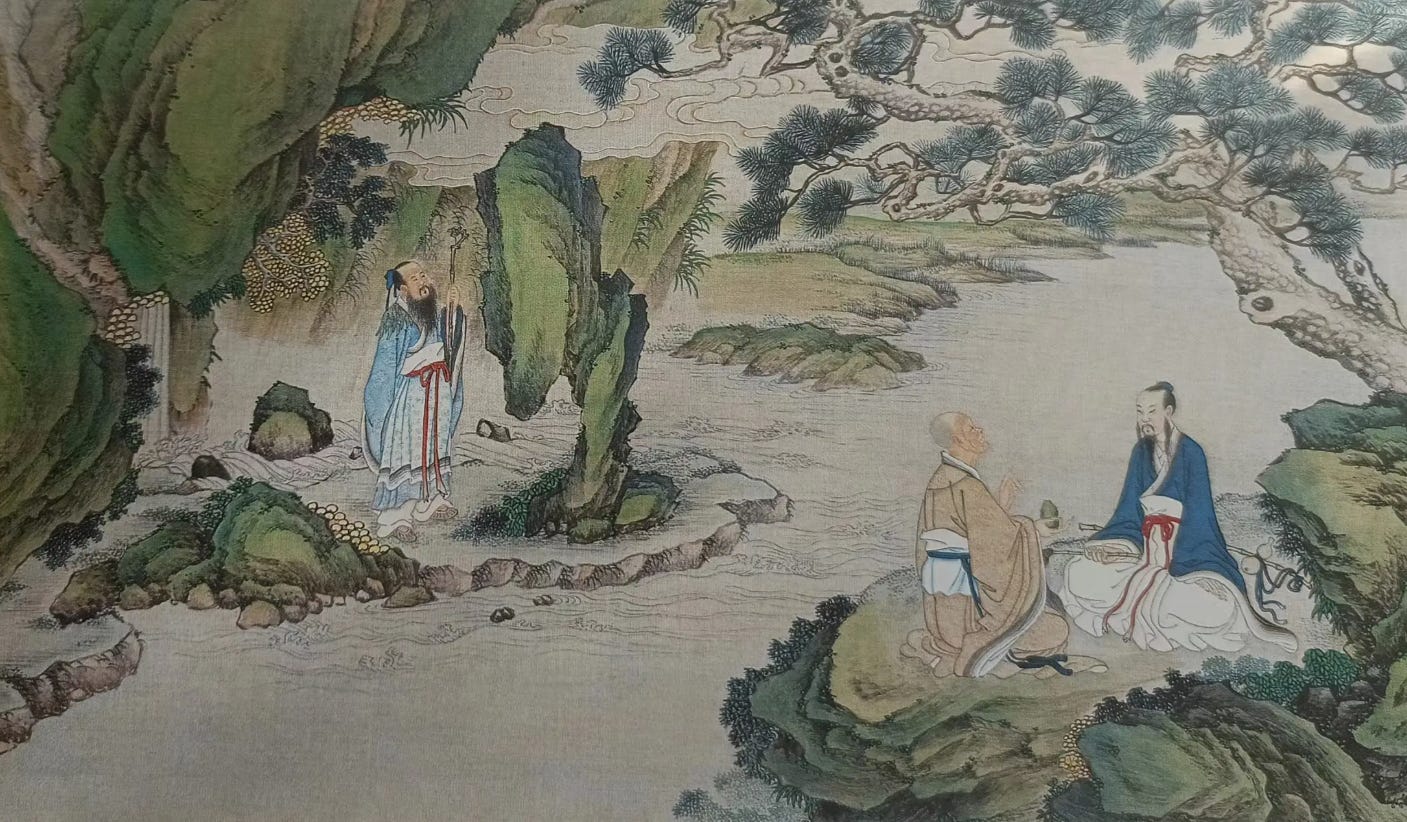
One day as the stone sat nursing its sorrows two holy men came walking up the path and sat for a moment to rest and converse in the shadow of Longago Peak. One of them, a bald monk in flowing robes, picked up the stone—which at that point was the size of a fan pendant—and gazed at its glittering surface, smiling. “I sense magic in you,” he said. “though nobody would know it from looking at you. What a stone like you needs is a taste of the mortal world. I’ll take you to a place I know of where all is opulence, poetry, verdure, and refinement. But first I ought to inscribe a few words on you, so that people know you’re no ordinary stone.”
The stone was delighted. “What are you going to write on me?” it cried. “Where are you going to take me?”
“Wait and you’ll see,” replied the monk. Pocketing the stone, he got up, and together the two men wandered off into the mountains.
After who knows how many numberless ages another pilgrim came this way, this one a Taoist mystic who called himself Futility, and he noticed that on a large stone near the path a long inscription had been carved. Pausing to read it he learned that this stone, having been discarded by the goddess Nuwa, had been found by two holy men called Infinity and Impossibility and taken down into the Dust, where it was incarnated as a man. The inscription consisted of a strange, meandering story full of trivia, gossip, and picayune details of daily life, larded through with poems and riddles. On the back of the stone was a couplet:
Denied the sky, I spent my life in the Dust.
Who will tell my tale? It is you, I trust.
“Of that I’m not so sure, Stone,” said Futility. “There are some intriguing details here, that I’ll own. But there’s no grand drama, no edifying social message, no noble characters who can serve as moral exemplars, not even a clear historical setting. It’s simply a collection of anecdotes about the follies, foibles, passions, and enthusiasms of a group of frivolous young women, distinguished by a few modest talents and virtues. It hardly strikes me as fit material for a book—at least not one that anyone would care to read.”
“Oh, don’t be silly!” cried the stone. “Do you really think my story would be more worth reading if I set it in the Han or the Tang dynasty, gave my characters the names of historical figures and had them speak in ‘thees’ and ‘thous’ while engaging in torrid love affairs? Or if I filled it with doomed romances between handsome young scholars and beautiful women? Would it be better if I spun a rote plot around a few love poems, embroidered it with flowery prose, and added a servant girl for comic relief? It would be fresher and more interesting, I think, not to employ those tired formulas, and instead write things exactly as I remember them. For I’ve spent half a lifetime observing those “frivolous young women,” as you call them, and even if their stories can’t compare with those of the great heroes of old, they are, at least, true to life, and I hope that counts for something. A glimpse into their world might provide amusement in idle hours, or a diversion in moments of melancholy, or perhaps might serve as a reminder of the things that really matter in life.”
Futility said nothing for a while, considering this. Then he read the writing on the stone over again, and he began to see the stone’s point. He began copying it out. In the process of copying it, he came to love these characters and the world they inhabited; and slowly, without realizing it, he found himself abandoning his pretense of caring nothing for fleeting human pursuits. He found himself moved by a love of humanity that a man of the Way like himself was supposed to eschew; and as he neared the story’s end, he felt his soul giving way to a soaring selflessness, a transcendent not-caring of the sort that opens itself only to those who have truly cared, a void brimming with its own emptiness. And so he changed his name to Desire and the name of the book to Record of the Monk Who Loved, and he took it back with him into the world of the living.
Thanks to him, it has circulated long among us, passed from hand to hand, rewritten again and again, going under many different names. Having labored for years in my little studio to edit it and adapt it to today’s reading tastes, I now offer you my version, and I will allow you yourself to decide whether Cao Xueqin’s verses about it were true:
All these tear-streaked pages,
sheer nonsense to read —
They call the writer a fool,
and pay him no heed.
So. Let us begin again. Dear Reader:
Long ago in the balmy southeast of this country in the fair city of Suzhou, tucked away in a narrow alley just off Ten-Mile Lane near the Changmen Gate, there stood a little temple called Calabash Temple, and next to the temple lived a retired magistrate named Zhen Shiyin. A quiet, unambitious man, Zhen spent his days tending his garden and writing poetry; his wife was a kindhearted, decent woman, and though they were not one of the city’s richest families, in that quarter they were certainly one of the most respectable. Their lives could be said to be complete except in one regard: though Zhen was well past fifty, the couple had no son, only a daughter, a baby girl named Yinglian.
One sultry summer day, Zhen was reading in his study when the book slipped out of his hand and he dozed off. He found himself in the midst of a dream in which he was walking—from where to where, he did not know—in the company of two men who seemed to be clerics of some kind.
“And what, pray tell, are you planning to do with that silly thing?” one of them, a tall man dressed in the black robes of a Taoist, was saying.
The other, a bald monk in orange robes, replied, “I know of a case about to be settled of a particular flock of souls, full of desire and soon to be made flesh again. I shall slip it in amongst them and none shall be the wiser.”
“I see,” said the tall black-robed one. “Those poor souls—they never learn, do they? So what kind of a tale is it to be this time? How did it begin? And where will it play out?”
The monk smiled. “It’s a long story and a strange one. You’ll find it amusing, no doubt. You see, after it became clear that the Mother Goddess had no use for this stone, it went off wandering about the Other Lands until one day it arrived at a place called Afterglow, the palace of the fairy queen known as Disenchantment. Knowing it to be no ordinary stone, she gave it a place at her court and named it the Grand Glimmer of Afterglow. To the west of the palace the Spirit River flowed past the Rock of Rebirth, and there, while strolling along the riverbank, the Grand Glimmer, as he was now called, noticed a pretty little heartweed plant growing at the foot of the rock. He took a liking to it and watered it every day with magic dew, and slowly, nourished by the clear liquor of Heaven, the plant assumed the form of a young woman. She spent her days roaming the lands beyond Farewell, foraging for sweet wild secrets and drinking of the plangent waters that flowed there. Yet deep in her heart she was unhappy, for she knew she owed a debt for the gift of her life, and she did not know how to repay it.
“Often she lamented: ‘Alas, I have nothing with which to repay the gift of the water he gave me! If only I could be born as a human woman, then I would weep a lifetime’s worth of tears for him, and perhaps that would suffice!’
“Hearing this, a great many other souls of that realm were filled with the desire to become human, and together they presented their case at the court of Disenchantment. And that is where we are going right now. We must get this thing registered and send it down into the Dust together with them, and thus complete the circle.”
“Ha!” laughed the Taoist. “Amusing indeed. A lifetime’s worth of tears, is it? Then let us go with them. Perhaps we may do some good down there.”
“My thought exactly. We must hurry though. Half of them have already departed.”
At this point Zhen Shiyin, unable to restrain his curiosity any longer, spoke up, clasping his hands in greeting and addressing the two men:
“Ahem, sirs… your most holy selves… pardon the intrusion, but I was just listening to your conversation, and I must say I’m fascinated to hear such a learned discourse on the hidden ties that bind our lives and the secret order of the universe. Could I trouble you to answer a few more questions? There’s much I still do not grasp, and if you could enlighten me it would perhaps save me from some of the suffering this world holds in store for me.”
The two men smiled.
“I’m afraid we cannot. Some mysteries must remain mysteries,” said the Taoist.
“Remember us, though,” said the monk. “For if you do, when the times comes, you may yet escape the flames.”
Disappointed, Zhen said, “Very well, that stands to reason… But there’s one other thing, if may I ask. What is this ‘silly thing’ of which you speak?”
“Ah, that,” said the monk, reaching into his robe. “This much, I think, is given to you to know.”
He took out something and tucked it into Zhen’s palm. Opening his hand, Zhen looked down and saw a lustrous green stone with words carved on it:
THE AWAKENED JADE
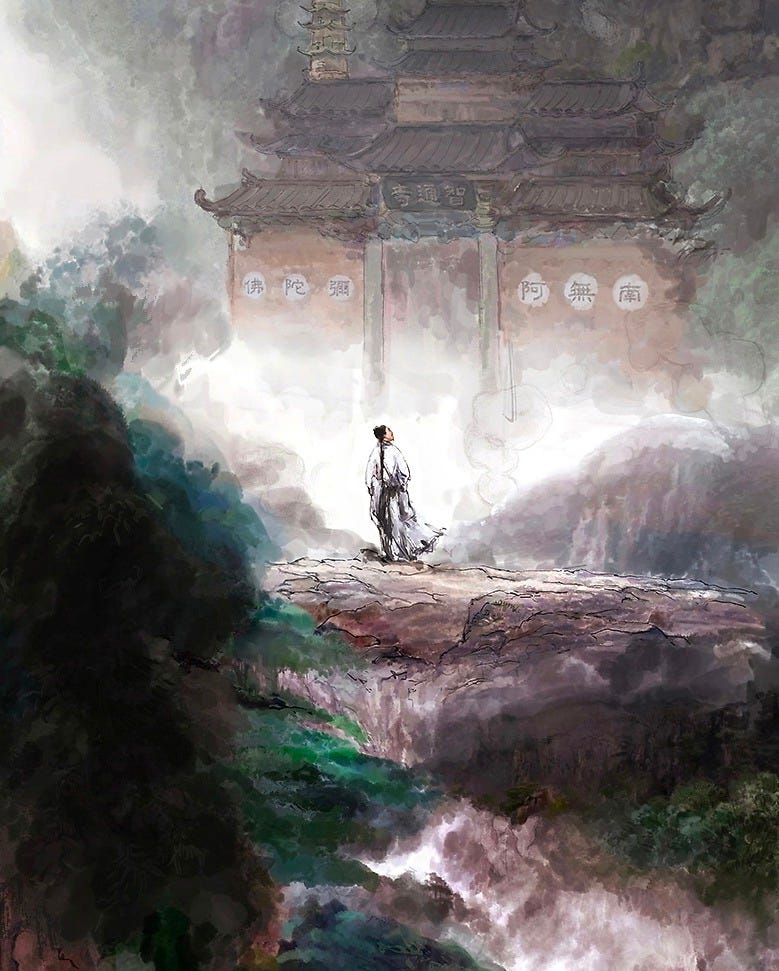
Turning it over, he saw that more lines of writing were inscribed on the back, but before he could read it the monk announced, “We’re here,” took the stone back, and together with the Taoist he disappeared through a great archway upon which was written:
ILLUSION WELCOMES YOU
On either side of the gate, framing it, was a pair of mottos:
~ What is is not, what is not is ~
~ Where nothing is everything, everything is nothing ~
Zhen tried to follow them through the gate, yet he had not gone but a few steps when there was a great crack like a thunderbolt—
—and he awoke with a gasp in his study.
He rubbed his eyes. The sun beat down on the leaves of the banana trees in the garden outside.
He was conscious of having had a dream, yet he had only the dimmest memory of what it was. As he struggled to recall it, the nanny walked in with Yinglian in her arms. The girl was almost three, and her delicate little face seemed more adorable by the day.
He took her in his arms and dandled her on his knee, stroking her hair. Then he got up, carried her over to the doorway, and stood there awhile watching the goings-on in the street.
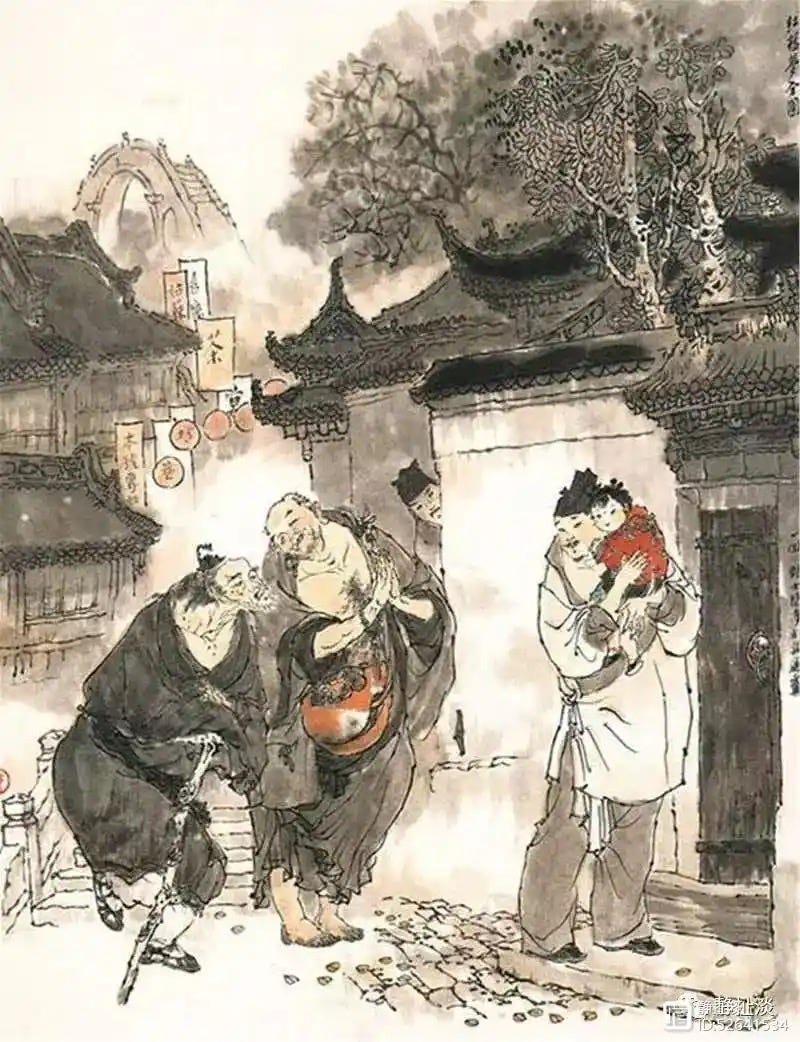
He was just about to go back inside when he saw two strange-looking men approaching down the lane. They looked like vagrant pilgrims of the kind one sometimes saw abroad in that city: a stout, barefoot, scabby-headed bald man who looked to be a monk, and a tall thin man with wild hair who walked with a limp, dressed in the black robes of a Taoist. The two men were gesturing energetically and seemed deep in conversation; but when the monk noticed Zhen Shiyin standing in the doorway with Yinglian in his arms, his eyes widened and he stopped short, then abruptly he burst into tears.
“Master!” he wailed. “Oh master! Why are you holding that poor little thing! Doomed! Bane of her whole family! Oh! To think of it…”
It was obvious the man was mad. Zhen tried to ignore him. Yet he continued:
“Oh! Give her here, give her to me, oh, the poor, poor thing…”
Zhen turned on his heel and walked briskly back into the house, clasping the girl to his bosom. He heard the man laugh, then shout after him:
The babe’s smile mocks the father for a fool—
The pretty maid, match for the cruelest of the cruel—
Beware the fifteenth night of the year
For smoke shall sweep away all you hold dear—
Zhen stopped, wondering if he should ask the man what he meant by this. As he hesitated, he heard the Taoist say to his companion, “Let’s part ways here, there’s no need for us to travel together. We each have our own work to do. I’ll be waiting for you three aeons hence at Beimang Mountain, and from there we can return to the realm of Illusion to close the case.”
“Till then!” said the monk, and they were gone.
These were no ordinary men, clearly. Zhen Shiyin stood turning their words over in his mind, regretting that he hadn’t asked more of them when he had the chance. Right at that moment, though, his ruminations were cut short by the young scholar who rented a room next door in Calabash Temple, who seeing him standing in the doorway came out and greeted him with clasped hands and a slight bow.
“What interests you so much in the street, my worthy friend? Is something going on?”
Zhen chuckled. “Ah, it’s nothing…” he replied. “My little one here was just crying and I brought her out to play. Would you care to come in and sit in my study? This heat is unbearable, and I’m a bit at loose ends.”
The young man’s name was Jia Yucun. He came from a distinguished family in the Huzhou area, yet over the generations their wealth had dwindled and their numbers shrunk, till now he was the last of his line. With no prospects for him at home, he had set off for the Capital in hopes of rekindling his family’s fortunes. But upon reaching Suzhou his funds had run out, and he had been lodging at the temple and working as a copyist in hopes of scraping together enough money for the next leg of the journey. Both men being of the scholarly persuasion, they saw a great deal of each other’s company.
Zhen Shiyin handed Yinglian off to her nanny and ushered Jia Yucun into the study. But just as the tea service was brought in and the two were getting settled, a servant stuck his head in, saying: “Sir, the old Master is at the door.” Zhen got up quickly. “Forgive me for abandoning you,” he said. “This won’t take long, I hope.”
“All the better to enjoy the comforts of your study,” said Jia. “You know this place is like a second home to me.”
Jia sat there leafing through Zhen’s poetry books, and after a while he heard a quiet cough outside the window. Getting up, he peered outside and saw a servant girl picking flowers in the garden. There was something about her face that compelled his eye to linger on her: though not ravishingly beautiful, her fine-boned features had a quality that spoke to him somehow.
Just as she was about to leave, she glanced up and saw Jia framed in the window: a young man with chiseled features and a confident, erect posture, wearing a faded headscarf and robes that looked the worse for wear. She turned quickly, averting her gaze, thinking that this must be the Jia Yucun her master often mentioned, for she knew of no one in the Zhen family who was so poor—and no wonder her master said this man was destined for better things, and that he hoped to help him if given the chance. She glanced at him again, and Jia, seeing this, was overcome with delight, feeling certain that those eyes had taken the measure of his soul and seen him for the kind of man he truly was.
Just then Zhen’s servant boy came in and told him that the guest was staying for dinner. At this Jia took his leave, slipping out the side door and down the passageway, back to his little room in the temple.
The weeks passed, and soon the Mid-Autumn Festival was upon them. After the festivities were over, Zhen took a stroll over to the temple to see how his friend was getting on. In the weeks since that moment in Zhen’s study, Jia’s thoughts had often dwelt upon the servant girl, and now, with the moon bright overhead and her image circling in his mind, poetic fervor overcame him and he found himself chanting a verse he had just composed:
What new destiny unforeseen
Revealed in the moonlight’s silvery sheen
Was minted by the happy chance
Of that questing eye, that backward glance
Alighting on a brow by sorrow vexed,
Promising love in this life, or the next—
If ever my fortunes should be reversed,
Ah, moonlight! May you crown her first!
Having spoken these lines, Jia fell to brooding on the frustrations of his life and his grand hopes that seemed more unattainable by the day. Then a new couplet sprang to into his mind and with sudden passion he declaimed:
Who will see this stone and recognize its worth?
When will the jade swallow at last take flight?
“You are man of no mean ambition, friend!” said Zhen, walking in right at that moment.
Jia laughed and said quickly, “Ah, it’s nothing. I was just reciting some lines I read the other day. What brings you here tonight?”
“I thought you might be lonely. It’s the Moon Festival, after all, a day for reunions—and here you are with only the monks for company. Would you care to come over to my place for something to drink and a midnight snack?”
“I certainly would,” said Jia, making no pretense of turning down Zhen’s offer. And so the two men repaired to Zhen’s study.
After they’d taken tea and refreshment, they retired to the couches and soon were deep in their cups. As singing and music echoed in the lane outside and the full moon wheeled higher in the sky, their talk grew more animated, their sentiments loftier, their toasts more and more extravagant. Quite drunk now, Jia rose, throwing back a cup, and extemporized a verse:
“In the court of the starry aether
the bright moon claims its place,
while far below, the people gather,
its glory reflected on every face—”
“More, more!” Zhen cried. “Go on, go on!”
“The city bathes in dappled splendor…
and all is wisdom, calm, and grace!”
“Beautiful!” Zhen exclaimed. “It’s a sign, I tell you—I’ve always said, Jia Yucun is not a man who will remain in obscurity for long! It’s only a matter of time before you claim your place among the worthies of the realm.” He quaffed a cup, and Jia drained his own, and then heaving a sigh, Jia said:
“If only that were true. I swear, it’s not just the wine talking—I know have the skill to win distinction in the Exams. But the Capital is such a long way from here, and I fear I’ll never make it there on the pennies I’m able to earn writing out other people’s letters here in Suzhou—”
“Ah, but you should have said!” Zhen said, cutting him off. “I’d long suspected that, but you never said it outright, and I didn’t want to presume. Though I don’t have the kind of talent you do, I know what it means to be a friend. Let me pay for your journey. If you set off now, you can be in the Capital in time for the spring rounds, and this time next year we’ll be toasting your success!”
Zhen ordered a servant to bring fifty taels of silver and two sets of winter clothes. “This should be enough, I hope,” he said. “The stars will be aligned on the nineteenth, that would be an auspicious day to depart.”
Jia accepted the clothes and silver quietly, without fuss, and the two men went on laughing and drinking far into the night.
When Zhen woke the next morning the sun was high in the sky. Thinking back on last night's conversation, he sat down to write a few letters of introduction for Jia to take to the Capital, so that he might find lodging with one of the mandarin families he knew there. But when he sent the letters over to the temple, his servant came back bearing word that Jia had set off at the fifth drum that morning, leaving a message for Zhen: “No day is inauspicious for a man of learning. You’ll forgive me not bidding you farewell in person."
Autumn passed, then winter came, and with it the New Year. On the night of the Lantern Festival, Zhen and his wife sent Yinglian out with a servant from their houshold to watch the lantern displays. But in the midst of the festivities the servant left the little girl sitting on a doorstep as he went to relieve himself, and when he returned, Yinglian was gone.
He searched for the child all night, but to no avail. When morning came, afraid to go back and face his master, he fled the city.
When Yinglian and the servant did not return that night, the couple knew something was wrong. Their other servants scoured the neighborhood, yet no one could find the girl. As she was the only child they had begotten in all their years together, their grief was of a special kind; they spent many sleepless nights in tears, and even thought to end their lives. Within a month Zhen took ill, and soon after so did his wife, and doctors were in and out of their house every day.
Then on the fifteenth of Thirdmonth, the monks in Calabash Temple were frying cakes for offerings when a grease fire set the windowpaper aflame. As fate would have it, most of that quarter of the city was built of bamboo and wood, and so, one after another, with terrible inevitability, the fire leapt from house to house to house until the whole street was a roaring volcano. The city guard was called out and many townsfolk rushed to the scene, but it was too late; the blaze was unstoppable. It burned all night, swallowing countless homes, and Zhen’s residence, being next door to the temple, was among the first to be consumed. The family escaped with their lives but nothing else, leaving Zhen to wail and curse over the smoking rubble.
After talking things over with his wife, Zhen decided they should move to his country estate. But the harvest was bad that year and the land was overrun with bandits and the soldiers fighting them, and so the place offered little in the way of refuge. In the end Zhen had no choice but to sell his lands and take his wife and two servants to go live with his in-laws.
His father-in-law, a well-to-do farmer named Feng Su, was not overjoyed to see his daughter and her distinguished husband wash up on his doorstep in such a sorry state. Fortunately, Zhen had brought the silver from the sale of his lands, which he gave to Feng, asking him to purchase a house for him and some land nearby to support them. Feng, after skimming off a hefty portion for himself, used the money to buy them a shabby little house and some meager fields. Zhen eked out a living there for another year or so, but a lifetime’s schooling in arts and letters did not prepare him well for the management of crops, and his family fell deeper into poverty. Feng always had a tart word for Zhen when the two crossed paths, and to everyone who would listen he complained that his son-in-law was a lazy good-for-nothing. Hearing this did nothing to raise Zhen’s spirits. And so Zhen, an old man bent under the double assault of illness and poverty, still reeling from the losses of that terrible year, fell to brooding on all the sorrows of his life, and began to take on the aspect of a man ready to exit this world.
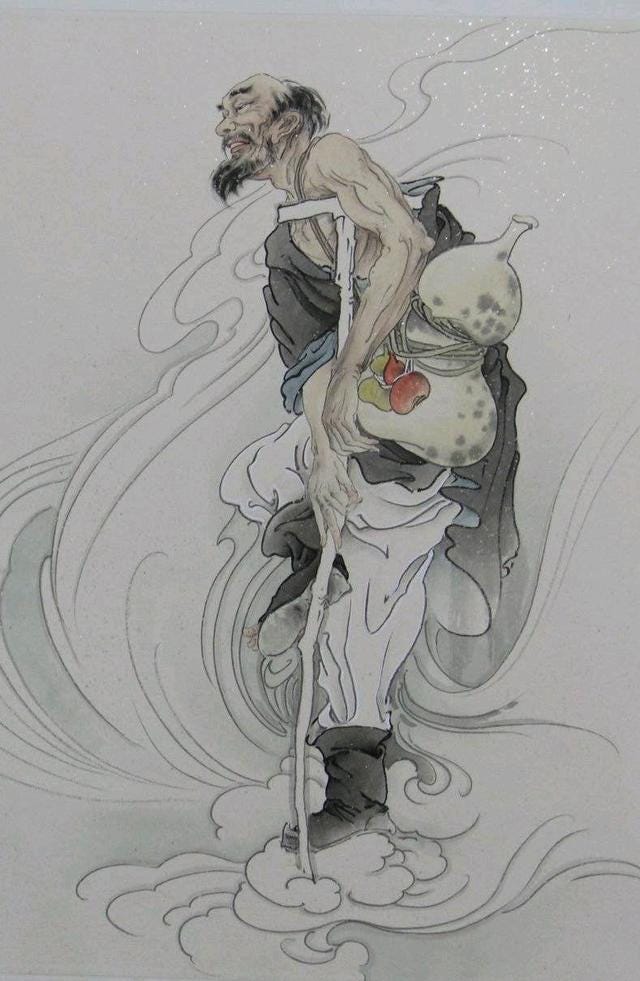
One day, leaning on his cane, he made his way out to the street for a breath of fresh air, when who should come limping down the lane but a Taoist clad in hemp sandals and a ragged tunic, with wild hair and a glint of madness in his eye. As the Taoist drew near, Zhen could hear him crooning a tuneless ditty to himself. It went like this:
Oh how we wish we could join the undying
But we just can’t let go of our hunger for fame
Kings and princes of yore
With their glorious deeds
Where are they now?
Covered over with weeds —
Fa la la lay-o, nothing can stay-o
Lee lee lee lo, all good things must go
Oh how we wish we could join the undying
But we just can’t let go of our yearning for wealth
Silver and gold
Set our eyes all a-glowing
But you can’t take them with you
To the place you’re a-going
Fa la la lay-o, nothing can stay-o
Lee lee lee lo, all good things must go
Oh how we wish we could join the undying
But we just can’t let go of our craving for pleasure
That pretty young lass
The new love of your life
As soon as you’re gone
She’s some other man’s wife
Fa la la lay-o, nothing can stay-o
Lee lee lee lo, all good things must go
Oh how we wish we could join the undying
But we just can’t let go of our hopes for our sons
Your pride and your joy,
Your whole reason to live,
As soon as he’s grown
No thanks will he give
Fa la la lay-o, nothing can stay-o
Lee lee lee lo, all good things must go
Intrigued, but catching only snatches of this, Zhen went up to the Taoist and said, “What are you singing? All I could make out was ‘fa la la lay-o,’ and something about the undying, and a whole lot of ‘good things must go.’”
The Taoist laughed. “Well, if you understood that last bit, I daresay you’ve gotten the whole point. In this world of ours, all that’s good will go, no? If it’s good, it’ll go, and if it won’t go, it’s no good. The good is in the going and the going is in the good. Isn’t that right?”
Hearing this, Zhen, whose wisdom ran much deeper than he realized, felt a new understanding dawning over him.
“Will you stay a moment?” he said. “I myself have a poem you might like.”
“Why of course,” said the Taoist, grinning. “I have all the time in the world.”
And Zhen recited:
I know of a hall with crumbling walls
Where scepters of power were laid
And a place of weeds and skeletal trees
Where painted dancers swayed
I know of a house with mahogany beams
Where spiders now spin in the gloom
And a hovel whose windows are hung with lace
And eyes that look out from a withered face
Once bedecked with rouge and perfume.
Just yesterday in the yellow earth
Old bones found their resting place
And tonight, by crimson lantern light
Newlywed lovers embrace
Coffers of silver, coffers of gold,
Fine garments of brilliant hue —
Now a beggar subjected to hoots and jeers
A life cut short in its finest years
Tomorrow, this could be you
The very best schooling money can buy
Can produce the most terrible brute
And the finest catch might sell her soul
In an alley of ill repute
A mandarin fancied a bigger hat
And ended up chained and disgraced
While a boy who shivered against the cold
Now finds his sumptuous purple robe
A bit too long for his taste.
So each of us acts out our part in the play
Each of us sings our song
We spend our years lost in a land faraway
Thinking this is the place we belong
We spin out our lives thinking there is here
While all along here was there
And every tragedy, every success
Is a stitch in a lovely wedding dress
For someone else to wear.
“Brilliant, brilliant!” the Taoist cried, applauding. “I like your poem indeed.”
“Let’s go, then,” said Zhen. He grabbed the traveling pack off the wanderer’s shoulders and slung it over his own. And the two of them drifted off down the road and away into the countryside.
When news of this reached his neighbors, Zhen Shiyin’s disappearance became the talk of the town. His wife, when she heard what happened, was inconsolable. She went to her father for help, and they sent searchers far and wide, but none brought news of her husband. Thus she had no choice but to move back in with her parents. Fortunately she still had two of her trusty maidservants in her employ, and they took to selling their needlework to supplement her father’s income. Feng Su complained about the arrangement, but there was nothing he could do about it.
One day the eldest of the two maidservants was out buying thread when she heard a great clamor of voices arise in the street: “The new Prefect is here! The new Prefect is here!” She ducked inside the door and watched as a troop of uniformed guards marched past, bearing a sedan chair in which sat a young man dressed in full mandarin’s regalia, with black winged hat and splendid crimson robes. Catching a glimpse of his face, she started; he looked strangely familiar. But she could not place him, and as soon as she went inside she forgot all about it.
Then, late that evening, just as the family was about to put in for the night, there came a loud pounding at the door and voices shouting: “Come out! The Prefect wants a word with you!”
Feng blanched. What new disaster was at hand?
If you wish to know, dear Reader, the answer awaits you in the next chapter.
Translation by Austin Woerner
Notes on the artwork:
Image 1: from 《脂砚斋重评石头记插图之二 》(“More illustrations for Red Inkstone’s Reannotated Story of the Stone”) posted on art platform ZCool 站酷 by artist Amuro Jiang (2020)
Image 2: from 《孙温绘全本红楼梦图》(“Complete Scenes from Dream of the Red Chamber”) by Sun Wen 孙温 (1818-1904)
Image 3: an illustration by artist Dai Dunbang 戴郭邦 (1938- ) for the 1978 English translation from Foreign Languages Press, published as Dream of Red Mansions
Image 4: from 《八仙人物图》“Eight Taoist Immortals” by painter Yu Zhiding 禹之鼎 (1647-1716)
I just finished this chapter in three sittings, and I'm so grateful I came across this translation. The introduction was already intriguing and felt modern almost, in the way it displayed self-awareness, humour, and directness. I would love to hear more on the translation of this part specifically... and I was especially impressed by the way you handled the poetry.
In the beginning, I felt a noticable difference between the prose and the dialogue -- the dialogue felt very strong to me, remniscant of the comedic rhythm in Chinese theatre sketches, while I feel like the prose would have done even better with a little more space and commas. But this is very nitpicky here on my part.
The amazing thing is that the part before the daughter gets lost and the fire takes its toll, and the whole downward spiral begins, I had goosebumps several times. I remembered very faintly the Chinese version of it, more specifically how my mother was reading and explaining it to me. This is a totally subjective impression of course, but to me that's a sign that the parts land very well, honouring each emotional beat of the original. On a deeper level, I was wondering if I remembered the reading and explaining also because in the English language, certain expressions have to be "explained" more and perhaps my mother was using similar descriptions in Chinese? I'm not sure how you see this or if this makes sense at all. In general however, I never felt like parts were over-explained. It was exceptionally smooth, so that the tragedy and themes of transience could really shine. I'm intrigued to continue reading. Thank you so much for this!
Love it! Cant remember the translation i read some time back but love this translation! I like your use of modern expressions.