
Chapter 2: In Which a Lady Dies in Yangzhou, and an Antique Seller Tells of Glory on Earth

Feng Su hurried to the door and greeted the yamen runners with an ingratiating smile.
“Is Zhen Shiyin at home?” they demanded. “We have orders to summon him to the Prefect.”
“I’m sorry,” said Feng. “I have a son-in-law by that name, but he ran off with a wandering holy man almost two years ago. We’ve had no news of him since.”
“In that case, we’ll take you instead. Come with us.”
The runners bundled Feng out the door, to the dismay of the rest of the family. When he returned several hours later he was greeted with anxious questions.
“The new Prefect’s a fellow called Jia,” he explained, “who says he had some dealings with our Shiyin awhile back. He saw Miss Almondblossom in the street, you see, and recognized her right away, so he guessed Shiyin must live here now. When I told him what happened to Shiyin he was mighty saddened to hear it. He asked about Yinglian, and I told him she went missing on Lantern Night, and he swore he’d do his best to find her. On the way out he said he’d gift us two taels of silver for our trouble.”
Hearing this, Zhen’s wife fell into a melancholy mood and said nothing the rest of the night.
The first thing next morning, runners arrived from the yamen bringing the promised silver, four bolts of brocade for Mrs. Zhen, and a letter to Feng Su from the Prefect saying that he desired the maidservant Almondblossom as a concubine, and would he please prevail on his daughter to offer her to him.
Feng was delighted at the prospect. After a quick trip back to the yamen to flatter the Prefect, he rushed home to cajole his daughter into agreeing to this proposition. And so that very night, a sedan chair arrived at the Feng residence and carried Almondblossom away to the yamen.
Needless to say, Jia Yucun was quite pleased with this result. He sent Feng Su a hundred gold pieces, as well as many gifts for Mrs. Zhen, so that they might live more comfortably while he made inquiries about her daughter’s whereabouts.
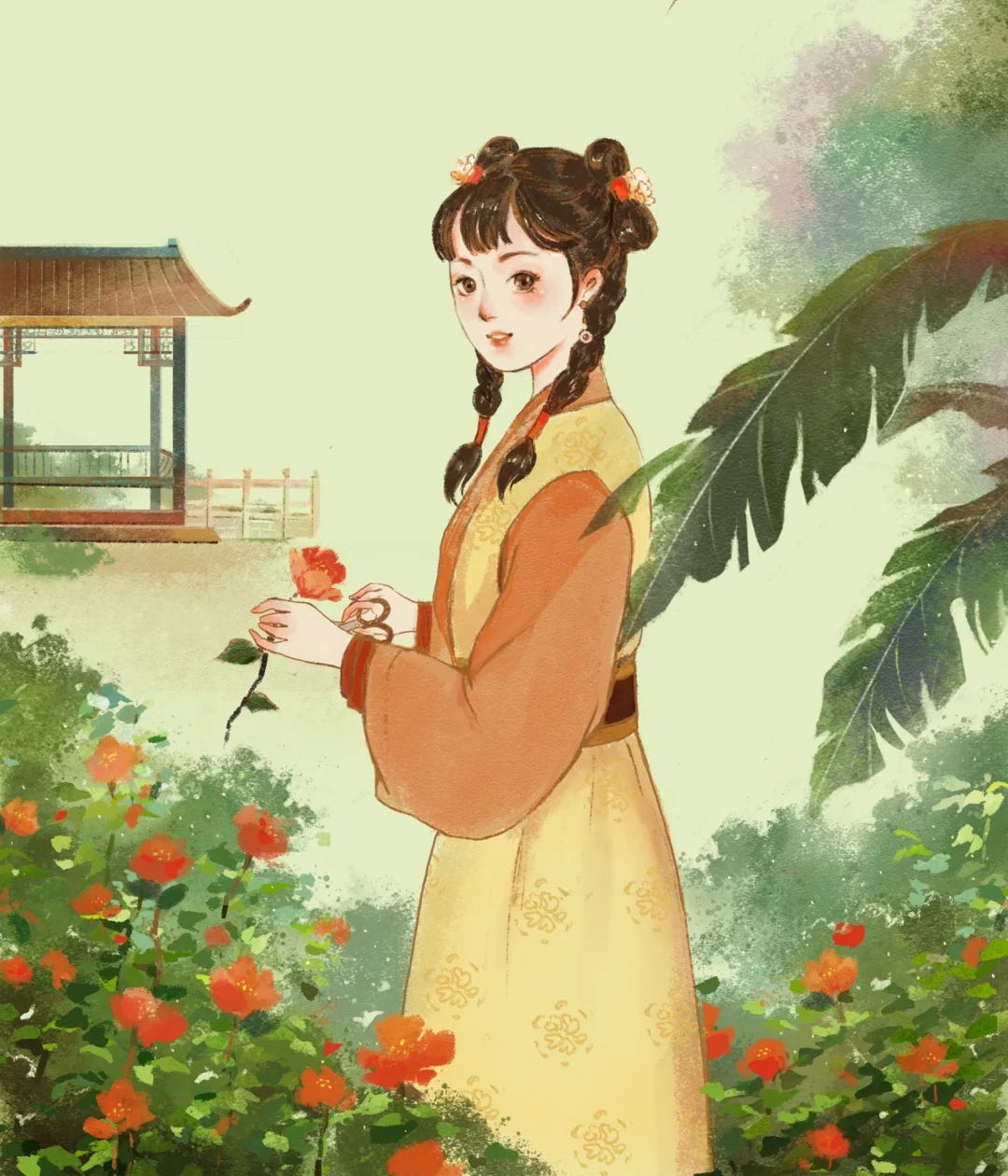
Almondblossom, of course, was the very servant girl who had traded a glance with Jia back in Zhen Shiyin’s garden—a fateful glance, as it turned out, for within a year she bore Jia a son, and half a year later his wife took ill and died, whereupon Jia formally wedded her. And so it happened that a chance meeting of the eyes turned a maidservant into the wife of a mandarin.
Jia Yucun, after accepting Zhen’s gift of fifty taels of silver back in Suzhou, had boarded the next river boat to the Capital, where he sat the Triennial, won a presentate degree, and was chosen for provincial service. Now, as fate would have it, he had been assigned the prefectship of this very county. Yet though he proved an able administrator, he soon gained a reputation at the yamen of being overzealous and power-hungry. Before the year was out, the governor had written back to the Palace complaining that the new Prefect’s talents concealed a conniving nature, and accusing him of graft and of exploiting his position to cozy up to the local gentry. The Emperor was furious and ordered him dismissed. Jia, to his credit, received this news with calm dignity, and carried out his remaining duties without betraying a hint of the bitter rage he felt. His colleagues, for their part, were not sorry to see him go.
With the money he had saved from his short time in office, Jia sent his family back to his hometown and, thus unencumbered, set off on a tour of the famous sites of that part of the Empire. It was while visiting Yangzhou that he learned that the office of Salt Commissioner had just been filled by a man named Lin Ruhai. Lin had won floricept in the last round of palace exams and then served as Lantai Temple Legate; he came from an illustrious Suzhou family ennobled to the fourth generation by imperial decree, but Lin, being the fifth, had to make his own name in the Exams, and so he belonged to that rare breed, an aristocrat who was also an impressive scholar. Alas, Lin's line, though distinguished, was not a prolific one. His only son died young, and Lin, already in his fifties, was left with only a daughter, born to his wife Lady Jia, a five-year-old girl named Lin Daiyu. She was a lovely, quick-witted girl and by teaching her to read and write as might befit a son, her doting parents somewhat lessened their grief at her brother's passing.
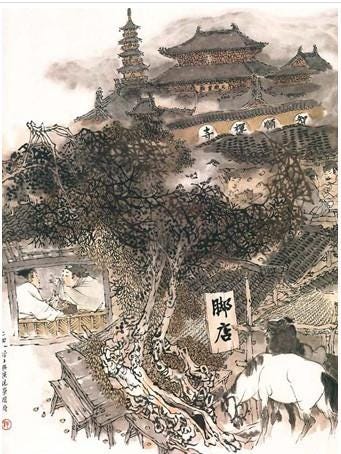
While staying in a Yangzhou inn recovering from a bad chill, Jia Yucun found he had nearly run out of funds, and two old friends he chanced to meet, knowing he needed more permanent lodging and that Lin Ruhai needed a tutor for his daughter, introduced him to the new Salt Commissioner. Jia found employment in the Lin household a pleasant enough circumstance in which to regain his strength, for overseeing one frail little pupil chaperoned by two maidservants was hardly an arduous task. And barely a year had gone by when the child's mother took ill and died, and between the bedside vigils and the rituals of mourning and the frequent failures of her own fragile constitution, the child had no time at all for her schooling. This left Jia mostly free to spend his days as he pleased. On afternoons when the weather was good he would take off for long rambles through the countryside, and one day his wanderings took him to a place of lush hills and meandering streams where, nestled among the tufts of a bamboo forest, he came upon a ramshackle little temple with peeling walls and a tumbledown gate over which was written:
THE TEMPLE OF PERFECT KNOWLEDGE
On either side of the gate was a pair of faded mottos:
He who has it all must grasp at everything
Only when we are lost do we turn to look back
"Hm," thought Jia. "This could be better written, but it does get at something profound. Strange that in all the temples I've visited I've never seen these mottos before. They must have been written by someone who led a most eventful life. I ought to go in and make his acquaintance."
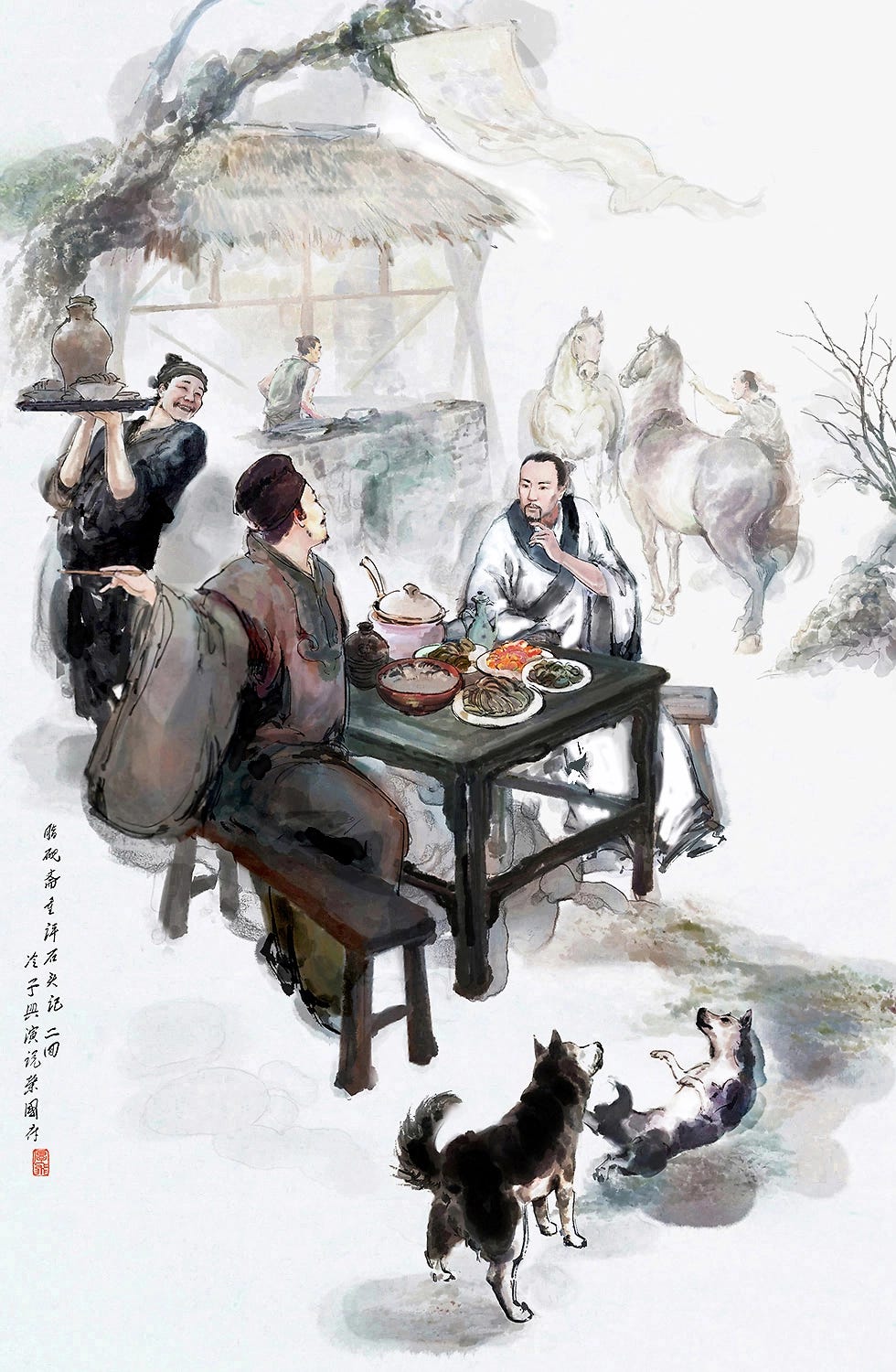
But when he went in, he found no one inside except a doddering old monk cooking a pot of porridge. He asked after the author of the mottoes, but the man seemed a bit deaf and perhaps not in his right mind, and Jia could make neither head nor tail of his nonsensical replies. Growing impatient, Jia went back out of the temple and betook himself to a tavern down the road, thinking that a cup of wine in these quaint environs would be a fine thing indeed. No sooner had he stepped though the door, though, than a man drinking at one of the tables stood up and cried out in a jovial voice: "Well, if it isn't Jia Yucun!"
Jia recognized, to his surprise, a friend of his from the Capital, a dealer in antiques named Leng Zixing. Leng was a supremely capable fellow, a quality Jia much admired, and Leng, for his part, was enamored of Jia's scholarly accomplishments, and so the two got along.
"Zixing, old friend! Fancy meeting you here!" Jia replied. "How long have you been in these parts?"
"I came home end of last year," said Leng, "and I was just on my way back to the city. I stopped by to visit an old friend of mine, and he insisted I stay a few days, and since I've got no pressing business I figured I'd take him up on his offer. He's busy today and I went for a long walk and ended up here. What a coincidence to find you, of all people, here in this place!"
He gestured for Jia to sit down and called for more food and wine, and soon the two were deep in conversation, recounting all that had happened since they'd parted.
"And what news from the Capital?" Jia inquired.
"Nothing much," said Leng, "but there's an interesting little piece of gossip being passed around concerning your relatives the Jias."
"My relatives?" replied Jia, puzzled. "But I have no relatives in the Capital."
"Surely you must have some connection with them? You share the same name, after all."
"But who?"
"The Jias of Glory on Earth! Who else? That's a family connection no one should be ashamed of!"
"Oh, that's who you mean," said Jia. "Yes, of course I know of them. It's true, we do trace our lines back to the same common ancestor. But there are Jias in every province of the Empire, and there have been since the days of the Han kings. We’ve had no doings with them for generations, and we wouldn't dare claim kinship with such an exalted house."
"Ah, but you know—" Leng said confidingly, "who knows how long their fortunes will last. The houses of Peace in the Realm and Glory on Earth are a pale shadow of what they once were!”
"A pale shadow? So vast and powerful a clan? Whatever do you mean?"
"It's a long story."
"Why, I remember passing by their estates on the way to see the Six Dynasties ruins, last time I was in the Capital," said Jia Yucun. "What a sight that was! Peace in the Realm on one side and Glory on Earth on the other, taking up nearly a whole city block! There wasn't a person to be seen on the street, but over the walls I caught a glimpse of all those grand halls and lofty pavilions, flourishing gardens full of towering rockeries... Such a vision of opulence as you wouldn't believe! That's what you call a pale shadow?"
Leng laughed. "For all your learning, there's much you still don't understand. As the ancients said, an insect with a hundred legs takes a long time to die. It's true, no run-of-the-mill mandarin's family could rival them in magnificence. And their numbers increase by the day, their affairs multiply, masters and servants alike live in luxury and all is a vision of harmony and order. But there's no one at the helm, no one planning for the future. With so much money spent keeping up appearances and no thought for thrift, dazzling though their facade may be, their insides will soon be all hollowed out.
"But that's not what I meant to tell you about. The more astonishing thing is the children. Every generation is worse than the last!"
Jia nodded thoughtfully. "But I’d think such a cultured family would make the schooling of their children their highest priority, would they not?"
"You would think so. Let me tell you the whole story. The first dukes of the two estates were brothers: Peace in the Realm belonged to the elder, you see, and Glory on Earth to the younger. When the old Duke of Peace in the Realm died, his son Jia Daihua inherited the title. Jia Daihua in turn had two sons, but the eldest died young and the title passed to his brother, Jia Jing. But Jia Jing had no interest in managing the household; he became enthralled with the mysteries of the Tao and spent his days in the company of magicians smelting cinnabar and mercury and the like. So he gave up the title in favor of his son, Jia Zhen. But Jia Zhen was no better than him, neglecting his duties in favor of wine and merriment, and no one dared rein him in.
"As for the Dukes of Glory on Earth, that's where we come to our interesting piece of gossip. The first Duke's son, Jia Daishan, sired two sons, the eldest of whom, Jia She, was a man of few accomplishments who did little to advance the fortunes of his house. But the younger, Jia Zheng, applied himself diligently to his books, and his grandfather encouraged him to make a name for himself in the Exams. When the old Duke died, though, passing the title to Jia She, the Emperor was so moved by his final testament that he immediately gave Jia Zheng an honorary magistracy and a post in the Ministry of Works. Jia Zheng's first son, Jia Zhu, showed promise as a scholar too, and married and produced an heir; but he took ill and died before his twentieth year. Jia Zheng's second child was a girl, born on the first day of the year—they said it was an omen. But the birth of his third child, more than a decade later, was a prodigy indeed. When the little boy was born, what should they find in his mouth but a shimmering piece of multicolored jade, with writing on it!"
Jia Yucun laughed. "This sounds like no ordinary child."
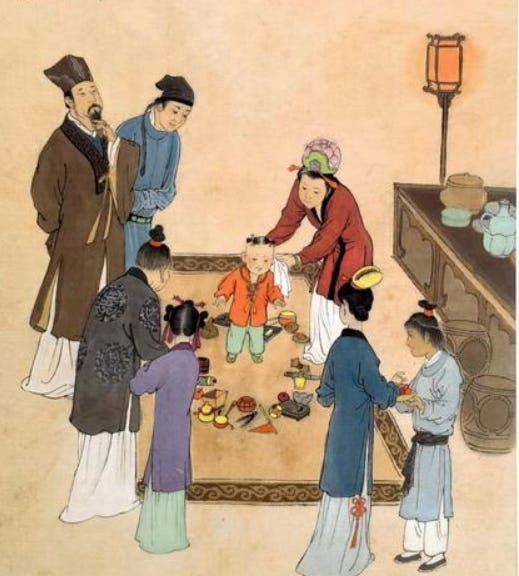
"No indeed," said Leng with a wry smile. "That's what they all said. The boy was much beloved, especially by his grandmother. But on his first birthday when his father sought to divine his inclinations in the usual way, laying out all manner of objects to see which one the boy would grab—of all the things spread out before him, what should he crawl over and pick up but a pot of rouge and some pieces of jewelry!
"Jia Zheng was furious, saying the boy would turn out to be a libertine and a degenerate, and from then on he took a special dislike to the boy. But the boy, whom they called Baoyu, still means the world to his grandmother, and she cherishes him like nothing else. Now he's ten years old, a fey, mischievous child and clever beyond his years... but he says the strangest things! 'Girls are made of water and boys are made of mud,’ he says. 'When I see girls I feel clean, but when I see boys I feel filthy and want to wash myself off.' Ha! What a rake that boy will be, when he grows up!"
"That's where you're wrong," Jia Yucun broke in suddenly, his face stern. "It seems to me that if you and the boy's father were acquainted with the right books and equipped with the proper tools of philosophy, you wouldn't hold such an opinion."
"Really? Then you must enlighten me, dear friend."
"In this world, one's capacity for good or evil is simply a matter of the circumstances of one's birth. The savior of the world and its destroyer are simply the same man, born under a different set of cosmic influences. I speak not of the average person, who will do nothing great at all, but of a person of a certain kind of extreme disposition, one who is destined to do great good or wreak great evil, depending on whether he was born at the right or the wrong time, under the influence of the righteous or the sinister essences.
"The great sages and wise kings of old, the Emperors Yao and Shun, King Yu the Tamer of Waters, the Duke of Zhou and Confucius and Mencius—men like these, who put the world to right, were born with an excess of the righteous essences; while the great usurpers and tyrants, the First Emperor and the rebel An Lushan, the devious Cao Cao and Qin Hui the Betrayer—these men were born with an excess of the sinister essences, and so became bringers of chaos.
"Now in peaceful and enlightened times such as the ones in which we live, when the essences of order and beauty inhere in so many men from the throne room down to the humblest cottage, there is a surplus of such righteous essences and they imbue every breeze and bedew all the land. The sinister essences, the source of all cruelty and perversion, flee from the sunlight and collect in dark crannies deep in the earth. But when there is a disturbance in the air and a whiff of the sinister rises and mingles with the righteous, the struggle between these two opposing forces produces a discharge akin to a flash of lightning, whereupon some of the sinister essences enter humanity. Those born under such influences will be neither great saviors nor great destroyers; their beauty or virtue will far surpass the common run of mankind, but so will their perversity. Born into noble families, they may act out legendary love stories; born into scholarly families, they may go down in history for defying the conventions of their day; born to common parents, they may win fame as performers or entertainers; never, though, will they become lackeys or underlings, willing servants of mediocre men. To this class of person belong many of the celebrated eccentrics, aesthetes, and iconoclasts of history: Tao Yuanming the hermit poet, the Seven Dwellers in the Bamboo Grove, the painter Ni Zan, the Emperor Song Huizong, the courtesans Zhao Yun and Xue Tao. All these men and women, born in different places and times, have essentially the same character."
"You're saying, then," said Leng Zixing, "that humans have no absolute moral natures, and whether we are remembered as virtuous or wicked largely depends on the morality of the world in which live?"
"That is precisely what I am driving at," said Jia Yucun. "And the child you describe strikes me as exactly this kind of person. In fact, in my travels this year I've encountered more than one child of a disposition very similar to this Jia boy born with the jade in his mouth. Do you know the Zhen family? Theirs is one of the most exalted houses in the City, where Lord Zhen is Commissioner of the Textile Authority."
"Why, of course I know of them!" replied Leng. "How could I not? The Zhens are close relations of the Jias. I've had dealings with them on many occasions."
"Last year, when I was in the City,” Jia went on, “I did a stint as a tutor in their household. What a post that was! Their wealth is spectacular, yet they are gracious people and have excellent taste. But the boy—teaching this one child his letters was more taxing than preparing a candidate for the Exams. He insisted he couldn't read unless accompanied by two girls, that he needed feminine company in order to focus on his books. He would even say to his servant boys: ‘You're not allowed to say the word “girl”! Don't you dare profane that beautiful word with those dirty mouths of yours. If you have to say it, rinse your mouth out first! Do you want to go to hell?’
"He was the most willful, petulant child I'd ever dealt with. But the instant he was with those girls he was all sweetness and charm. The rod did nothing to reform him, and every time his father beat him he cried out, 'Sister! Sister! Sister!' Hearing this, his sisters laughed at him, saying, 'Why were you calling for us? Were you hoping we'd go in and beg for mercy on your behalf?' He replied, 'It just feels better to say the word, that's all. It's my special little trick. It makes the blows hurt a little bit less.'"
"Of course, the boy's grandmother, who spoils him rotten, blamed me and his father for everything. It wasn't long before I put in my resignation. I don't know what will become of a house whose fortunes are riding on the shoulders of an heir like that. The pity is, his sisters really were excellent young women."
"The Jia girls are quite something as well," said Leng Zixing. "The eldest, Yuanchun, entered the Palace as an Imperial concubine. The other three, Yingchun, Tanchun, and Xichun, are much doted on by old Lady Shi, the boy Baoyu's grandmother, and given an education, and said to be outstanding students."
"Could they not have given their daughters more dignified-sounding names, though? I always admired the way the Zhens gave their girls proper names, just like their brothers."
"Do you not remember I said Baoyu's sister was born on the first day of the year?" said Leng. "That is why Yuanchun was given her name—First of Spring. The others' names were chosen to answer hers. That generation was special, though. The others have always been named after the fashion of their brothers’, and the proof is in the name of your employer's wife. Lady Jia is Jia Min, sister to Jia Zheng and Jia She—were you not aware?”
Clapping his hands together, Jia Yucun exclaimed with a laugh, "That explains a great deal! I wondered why my student, Daiyu, always omits a stroke or two from the character "min," and slurs the sound of it when she reads it out loud. So she's a child of the Jias of Glory on Earth! I always thought there was something unusual about her manner; she seemed different. Now that I know her mother was of such exalted parentage, it all makes sense. Was, though, alas—for only a month ago, her mother breathed her last."
Leng sighed. "That's sad news to hear. She was the youngest of three sisters, and now all of them are gone. Well, it remains to be seen how the next generation of Jia women will fare—and what kind of men they end up with."
"Indeed," said Jia Yucun. "So you were speaking of Jia Zheng, that he has a son born with a piece of jade in his mouth, and a grandson too. And what of his elder brother Jia She, then? Does he have an heir?"
"Jia Zheng fathered another son by a concubine, though of that one I know little. As for Jia She, he has a son named Jia Lian, a crafty, dissipated young man never much inclined to study, for whom the family purchased a magistracy and who helps his uncle manage some of the family affairs. But his wife—she's a force to be reckoned with! Everyone praises her for her beauty, her silver tongue, and her intelligence, saying she's the equal of any man, and puts her husband in the shade."
Jia Yucun smiled. "I have the feeling all these characters we've been talking about embody some combination of the righteous and sinister essences."
"Righteous or sinister, you should have another cup," said Leng. "Summing up the destinies of other people's families is thirsty work."
"I fear I've had too many already."
"Ah, but wine goes so well with gossip," Leng said with a smirk. "Are you sure you don't want another?"
"It's late," said Jia with a glance out the window. "I should get back before they close the city gates. Would you care to walk with me? We can continue this conversation on the road."
The two men rose and settled the bill. They were just on the way out the door, though, when they heard a voice shout from behind them in the tavern:
"Yucun, is that you? What are you doing here? You won't believe the news!"
And if you wish to know what that news is, dear Reader, there is nothing to it but to turn to the next chapter.
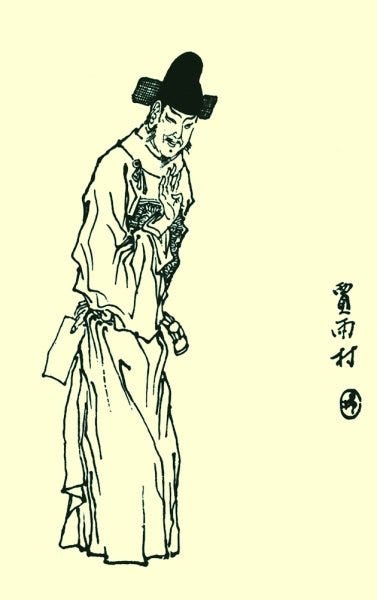
Translation by Austin Woerner
Notes on the artwork:
Image 1: a painting of zhua zhou 抓周 (first-birthday divination ritual) from 《古代风俗百图》 (“A Hundred Paintings of Ancient Customs”) by artist Wang Hongli 王弘力 (1927-2019)
Image 2: an illustration of Jiao Xing 娇杏 (“Almondblossom) from《刘心武爷爷讲红楼梦》(“Grandpa Liu Xinwu Tells the Story of Dream of the Red Chamber”) by illustrator Zheng Qinyu 郑琹语 (1994- )
Image 3: an illustration by artist Dai Dunbang 戴郭邦 (1938- ) for the 1978 English translation from Foreign Languages Press, published as Dream of Red Mansions
Image 4: from 《脂砚斋重评石头记插图之二 》(“More illustrations for Red Inkstone’s Reannotated Story of the Stone”) posted on art platform ZCool 站酷 by artist Amuro Jiang (2020)
Image 5: from《红楼梦人物百图》(“Sketches of Dream of the Red Chamber Characters”) by Dai Dunbang 戴郭邦 (1938- )
Ooof I’ve been wanting to return sooner and now finally have.
I loved the philosophy in this chapter… I hear my father and my uncles. This is precisely how men in China gossip lol